
Before this summer, if you’d ask me what a communications internship looked like, I would’ve said press releases, talking points, and maybe a flyer here and there. I pictured myself behind a laptop, polishing language, sending things out into the world and trusting that they’d land where they needed to.
Then I went out and actually did the outreach.
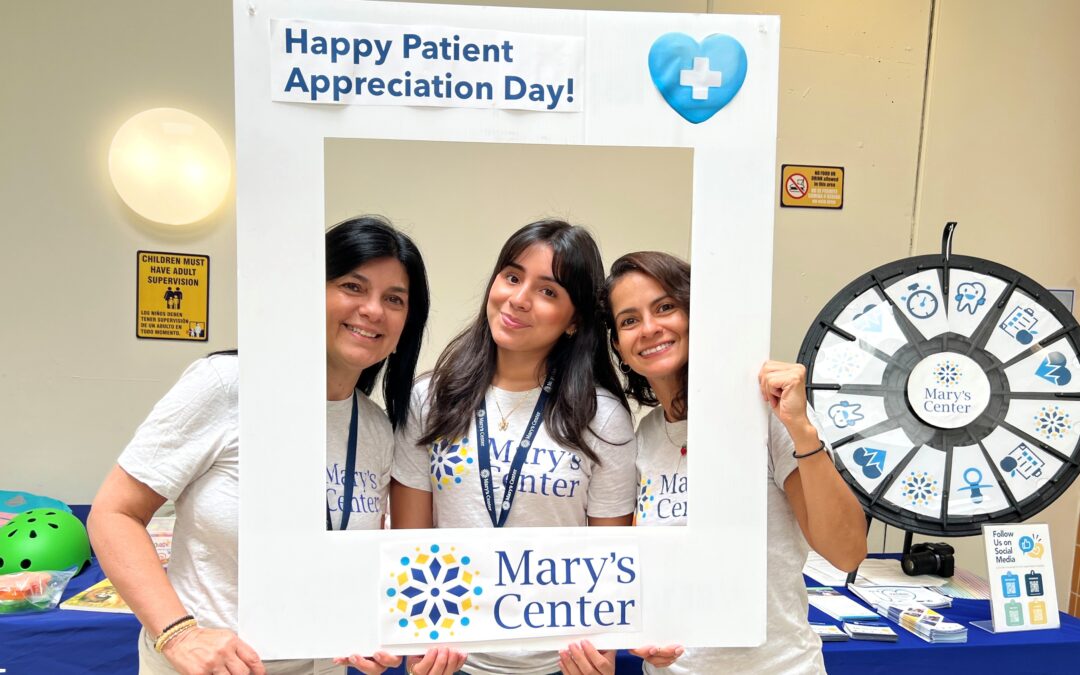
I remember standing at a table at an end-of-year celebration at one of the local schools, surrounded by families celebrating their kids finishing the year. And in between the congratulations and the noise, I kept having the same conversation, over and over, with parent after parent: they had no idea Mary’s Center existed. Not because it wasn’t there; it was, with its doors open just down the road. Not because the services weren’t real. They were. These parents just had never heard about it in a way that actually reached them. Not in their language. Not in a place they already trusted. Not from someone they believed was really there for them, and not just handing out papers.
And that’s when I understood something no training could have told me:
There’s no grass tops if the grass doesn’t grow.
All the strategy in the world, the polished messaging, the perfectly designed program, the beautifully built model, mean nothing if they never actually reach the person who needs them. A model is only as good as the outreach that surrounds it. I didn’t learn that from a memo; I learned it in a conversation that had nothing to do with a press release and everything to do with whether a person felt like they could trust what I was telling them.
The community I was doing this outreach for is home to one of the largest Salvadoran populations in the DC/MD region. Families who came here the way my own family did, looking for something safer, something steadier than what they left. And when I sat with them, I wasn’t just there to hand out information. I was there because, in a lot of ways, I was looking at my own family’s story, just told in a different house.
Going in, I thought my job was translation. Take the policy, take the program description, turn it into plain language, hand it over. Simple transaction. In one end, out the other.
But translation assumes the person already knows the question. It assumes the only gap is vocabulary, that if you say it simply enough, it’ll land. What I found instead was a much bigger gap, a real one, between institutions and the communities they’re supposed to serve. And closing that gap had almost nothing to do with word choice. It had to do with courage.
Courage in knowing that when you show up, you’re not just representing yourself. You’re representing an entire community, their trust, their story, whether they’re seen as more than a statistic. That’s a weight. And carrying it well is its own kind of courage.
Civic literacy isn’t just teaching people how a system works. It’s having the courage to stand in the space between a community and the institution that’s failed to explain itself and refusing to let either side give up on the other.
None of that is what I pictured when I thought “communications internship.” All of it turned out to be the actual center of the work.
Mary’s Center is built on a social change model most community health centers don’t have—healthcare, education, and social services, all under one roof, all treating a family as a whole instead of one patient at a time. It’s a genuinely good model. But what makes it work isn’t just the design. It’s the fact that Mary’s Center invests just as much in making sure people know it exists as it does in building it in the first place. Outreach is treated as core infrastructure, not an afterthought bolted on at the end.
In Florida, where my own family is from, I’ve watched what happens when that second half is missing. There are community health centers there too. There are services, technically, on paper. But the deliberate, resourced, in-language outreach that actually gets people through the door—the part that turns a good model into a usable one—isn’t built the same way. So a program can exist and still miss almost everyone who needed it, simply because no one ever told them, in a way they’d believe, that it was there.
That’s not a knock on any one place. It’s a pattern I think shows up across a lot of public interest work: we design the service carefully, and then we quietly assume the need will find its way to it on its own. It usually doesn’t. Someone has to go find the need. In the language it speaks. In the place it already is. That’s not an add-on to communications work; that is communications work. Somebody has to stand at the table.
That’s the part I didn’t understand before this summer, and it’s the part I want the next fellow to know going in: don’t assume good work speaks for itself. It doesn’t, not on its own. The work of making sure it’s actually heard by the actual people it’s meant for isn’t a side task you get to once the “real” communications work is done. It is the real work. If the message doesn’t land, the person who needs it doesn’t get it.
The grass has to grow first. Everything else, every press release, every talking point, every flyer, is built on top of that, not instead of it.